ETHICAL AND UNETHICAL ISSUES IN HUMAN RESOURCE
ETHICAL AND UNETHICAL ISSUES IN HRM
ETHICS IN HUMAN RESOURCE
Ethics refers to a system of moral principles - a sense of right and wrong, and goodness and badness of actions and the motives and consequences of these actions. In the business, businessmen must draw their ideas about what is desirable behavior from the same sources as anybody else would draw. Ethical values channelize the individual energies into pursuits that are benign to others and beneficial to the society. Ethical issues abound in HR activities, such as remuneration, labour relations, health and safety, training and development etc.
Beyond compensation and benefits, HR teams are now tasked with challenges like fostering diversity in the workplace, addressing issues of inequality and setting standards around workplace conduct.Often, human resources ethics policies around these issues can directly impact how a company attracts and retains talent. According to a recent report , for example, 79 percent employees said they would not accept a job with a higher salary from a company that has failed to take action in sexual harassment cases.while HR ethics conversations that challenge the status quo in the workplace are marks of progress, they require HR departments to make tough ethical decisions.

These are seven major issues faced by human resource, i.e, (1) Employment Issues, (2) Cash and Incentive Plans, (3) Employees Discriminations, (4) Performance Appraisal, (5) Privacy, (6) Safety and Health, and (7) Restructuring and layoffs.
1. Employment Issues:
HR professionals are likely to face maximum ethical dilemmas in the areas of hiring of employees.
Major challenges in this area are:
a. Pressure to hire a friend or relative of a highly placed executive.
b. Faked credentials submitted by a job applicant.
c. Discovery that an employee who has been with the organisation for some time, is skilled and has established a successful record, had lied about his educational credentials.
2. Cash and Incentive Plans:
Cash and incentive plans include issues like basic salaries, annual increments or incentives, executive perquisites and long term incentive plans
Basic Salaries:
HR managers have to justify a higher level of basic salaries or higher level of percentage increase than the competitors to retain some employees. In some situations, where the increase is larger than normal they have to elevate some positions to higher grades. Annual increment/incentive Plans. This situation is particularly true in case of top management executives. The fear of losing some outstanding executives, the HR managers is forced to give higher incentives to them than what the individuals actually deserve.
Executive Perquisites:
In the name of executive perquisites, sometimes excesses are often committed, the ethical burden of which falls on the HR managers. Sometimes the costs of these perquisites are out of proportion to the value added. For example, the CEO of a loss making company buys a Mercedes for his personal use or wants a swimming pool built at his residence.
Long term incentive Plans. Long term incentive plans are to be drawn by the HR managers in consultation with the CEO and an external consultant. Ethical issues arise when the HR manager is put to pressure to favour top executive interests over the interests of the other employees and the investors.
3. Employees Discriminations:
A framework of laws and regulations has been evolved to avoid the practices of treatment of employees on the basis of their caste, sex, religion, disability, age etc. No organisation can openly practice any discriminatory policies, with regard to selection, training, development, appraisal etc. A demanding ethical challenge arises when there is pressure on the HR manager to protect the firm or an individual at the expense of someone belonging to the group which is being discriminated against.
4. Performance Appraisal:
Ethics should be the basis of performance evaluation. Highly ethical performance appraisal demands that there should be an honest assessment of the performance and steps should be taken to improve the effectiveness of employees. However, HR managers, sometimes, face the dilemma of assigning higher rates to employees who are not deserving them; based on some unrelated factors eg. closeness to the top management. Some employees are, however, given low rates, despite their excellent performance on the basis of factor like caste, religion or not being loyal to the appraiser.
5. Privacy:
The private life of an employee which is not affecting his professional life should be free from intrusive and unwarranted actions.
HR managers face three dilemmas in this aspect:
(i) The first dilemma relates to information technology. A firm’s need for information particularly about employees while on job may be at odds with the employee’s privacy. Close circuit cameras, tapping the phones, reading the computer files of employees etc. breach the privacy of employees.
(ii) The second ethical dilemma relates to the AIDS testing. AIDS has become a public health problem. HR managers are faced with two issues: Whether all the new employees should be subject to AIDS test and what treatment should be melted out to an employee who is affected with the disease. It is however generally understood that since AIDS cannot be contracted by casual and normal workplace contract, employees with this illness should not be discriminated against and they should be allowed to perform jobs for which they are qualified.
(iii) The third ethical dilemma relates to Whistle Blowing. Whistle blowing refers to a public disclosure by former or current employees of any illegal, immoral or illegitimate practices involving their employers. Generally, employees are not expected to speak against their employers, because their first loyalty in towards the organisation for which they work. However, if the situation is such that some act of the organisation can cause considerable harm to the society, it may become obligatory to blow the Whistle. The HR manager is in the dilemma how to solve this issue between the opponents and defenders of whistle blowing.
6. Safety and Health:
Industrial work is often hazardous to the safety and health of the employees. Legislations have been created making it mandatory on the organisations and managers to compensate the victims of occupational hazards. Ethical dilemmas of HR managers arise when the justice is denied to the victims by the organisation.
7. Restructuring and layoffs:
Restructuring of the organisations often result in layoffs and retrenchments. This is not unethical, if it is conducted in an atmosphere of fairness and equity and with the interests of the affected employees in mind. If the restructuring company requires closing of the plant, the process by which the plant is chosen, how the news is to be communicated and the time frame for completing the layoffs is ethically important.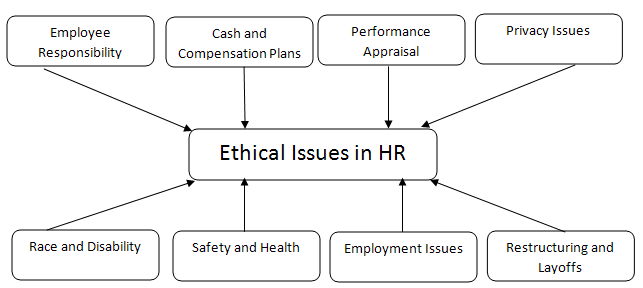


The information u gave ws very helpful for me to understand the topic so well......
ReplyDeleteEverything is well explained ,helped me a lot to know about HR ,thanku for such blog and I expect more from u in future...
ReplyDeleteWell explained and easily understandable also helpful for me..!
ReplyDeletecontent is good , but what you think that why ethics take place in every field ?
ReplyDeleteI think that trust is the main issue in ethics.it helps in every ethical field.thank you
DeleteThe data you gave is very good and well explained
ReplyDeleteBeing ethical in HRM is indirectly effect the growth of the company so it is important to be ethical bt i m against the process of selection of them it can be ethical or unethical
ReplyDeleteSir it can be ethical.
Deletewell explained.the data you gave is very helpful.
ReplyDeleteThis data is very helpful and relevant.well explained
ReplyDeleteThis data is very informative and helpful and was well explained
ReplyDeleteVery nice and informative ?
ReplyDeleteContent is very good and well explained.but try to put examples
ReplyDeleteExcellently explained in short ..digramiatically .. keep it up
ReplyDeleteThanks to all
ReplyDelete